


Blackcurrant: Fruity Depth and Green Nuance in Perfumery
Botanical Origins
Blackcurrant (Ribes nigrum) is a dark purple berry native to Europe and northern Asia. It grows on compact shrubs and has long been valued for culinary and aromatic uses. Known for its sharp juiciness and deep color, blackcurrant has featured in jams, liqueurs such as crème de cassis, and traditional herbal remedies. In perfumery, it offers both tangy fruitiness and a green, leafy edge that adds freshness and complexity.
Historical and Cultural Background
Blackcurrant has held significance in European traditions for centuries. Its leaves and berries were used for medicinal purposes, while its aroma gradually entered fragrance palettes in the 19th and 20th centuries. Recognized for vibrancy and depth beyond citrus, it became an important element in both mainstream and niche compositions, enriching fragrance design with its dual character.
Extraction and Aroma Materials
Blackcurrant does not yield essential oil through conventional distillation. Instead, perfumers work with specialized materials:
- Blackcurrant bud absolute (bourgeons de cassis) – Extracted from young buds, delivering powerful green, fruity, and slightly animalic tones.
- Synthetic molecules – Compounds such as blackcurrant mercaptan recreate the berry’s tart sharpness and juiciness.
- Accords – Blends of fruity esters, aldehydes, musks, and green notes designed to capture the essence of the fruit.
Because of its potency, blackcurrant bud absolute is used sparingly, shaping compositions with intensity and depth.
Olfactory Profile
The blackcurrant note combines fruit, green, floral, and subtle musky aspects. Its impression can range from ripe berries to crushed leaves, or even a fine liqueur. Key aspects include:
- Juicy fruitiness – Tart and mouthwatering.
- Green nuance – Leafy freshness that enhances brightness.
- Floral undertone – Soft notes that integrate with blossoms.
- Animalic facet – From bud absolute, adding raw intensity.

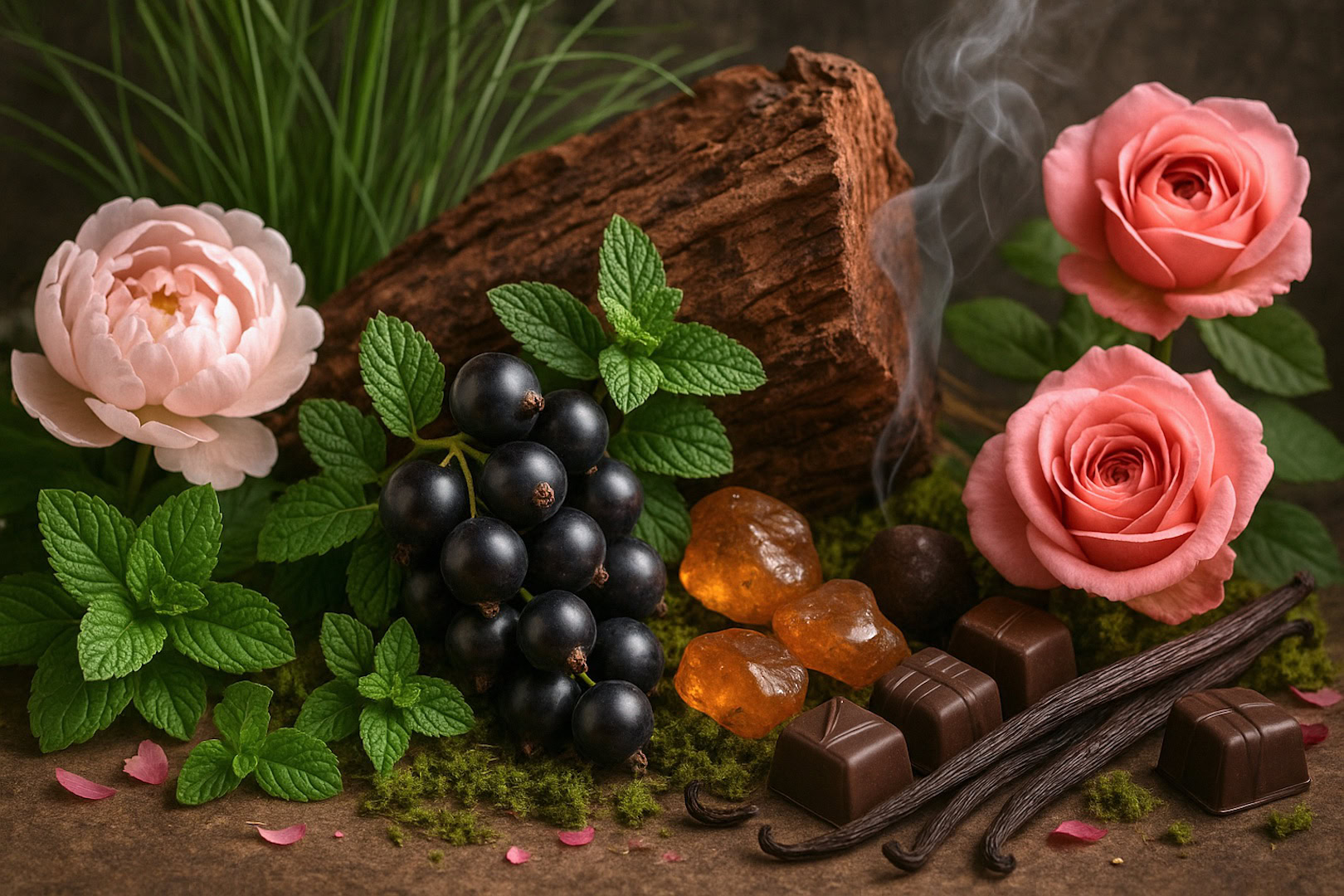
Role in Fragrance Composition
Perfumers employ blackcurrant to add texture, vibrancy, and nuance to multiple fragrance families:
- Fruity florals – Juicy lift to rose, jasmine, or peony accords.
- Chypres – Bright, tangy freshness balancing mossy bases.
- Gourmands – Contrasts sweetness of vanilla or praline.
- Green fragrances – Intensifies freshness with galbanum or violet leaf.
Aroma Chemistry
The distinctive scent arises from a complex interplay of natural and synthetic molecules:
- Blackcurrant mercaptan – Sulfur compound defining its sharp tang.
- Dimethyl sulfide – Adds leafy, green tones.
- Fruity esters – Provide juiciness and sweetness.
- Ionones – Contribute soft, violet-like floral depth.
Iconic Perfumes Featuring Blackcurrant
- Creed Aventus (2010) – Features blackcurrant in the opening, paired with pineapple and apple.
- Yves Saint Laurent Paris (1983) – Uses blackcurrant bud absolute for green vibrancy in a rose accord.
- Nina Ricci L’Air du Temps – Includes blackcurrant bud in its fruity-floral structure.
- Lancôme Trésor Midnight Rose (2011) – Highlights blackcurrant with raspberry and rose in a modern fruity-floral composition.
Sensory Impression
The impression of blackcurrant in perfumery is vivid and layered. It can recall ripe berries, green leaves, or the richness of liqueur. Its profile blends freshness, juiciness, and subtle depth, bringing natural energy to a fragrance.
Lasting Resonance
Blackcurrant remains an indispensable note in perfumery. Its unique balance of fruit and green qualities allows it to enrich both classic and modern creations. By adding freshness, complexity, and depth, it continues to inspire fragrance design across many styles and eras.


