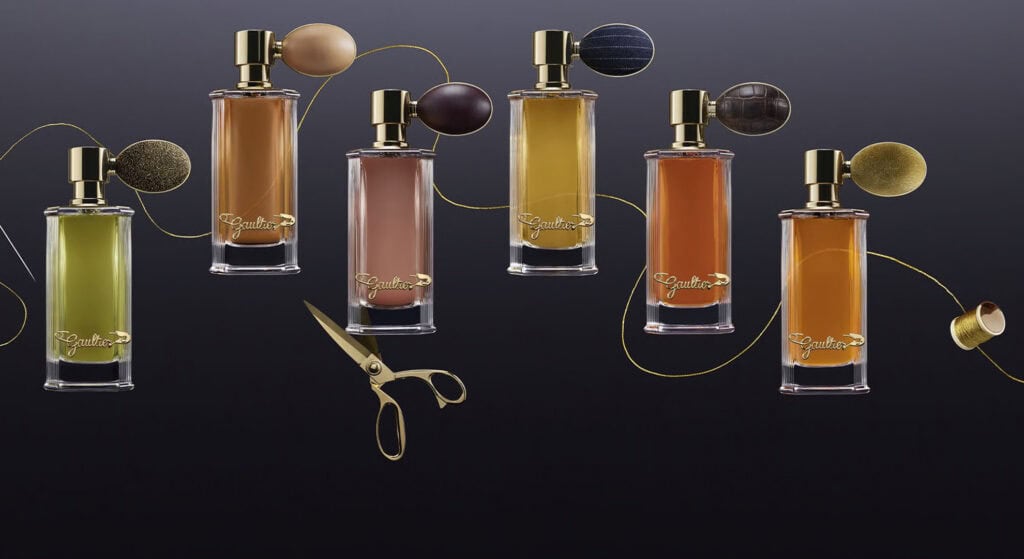
The six fragrances are Ambre Tatouage, Musc Terrible, Cuir 1976, French Oud, Rose Palace and Santal Paname. Amber, musk, leather, oud, rose and sandalwood define their individual olfactory identities. Each composition places these materials inside the creative vocabulary of Gaultier's own history.
Every fragrance carries an archival reference. A glove from 1984 enters the story of Ambre Tatouage. A reworked suit from the 2011 runway informs Musc Terrible. Cuir 1976 looks toward a leather jacket and Gaultier's independent work from 1976. French Oud references a python look from Fall-Winter 1999. Rose Palace turns toward the Paris club Le Palace and a Fall-Winter 2003 silhouette. Santal Paname draws its visual cue from a structured golden runway look shown in 2012.
That archive reaches the bottles. The collection uses a bulb atomizer with an individual material treatment for each scent: golden velvet for Ambre Tatouage, navy striped fabric for Musc Terrible, brown leather for Cuir 1976, python-effect leather for French Oud, burgundy leather for Rose Palace and golden mesh for Santal Paname. Fragrance and garment are connected before the perfume reaches the skin.
The project marks a deliberate expansion of Jean Paul Gaultier's fragrance universe. Ana Trias, president of prestige and fashion brands at Puig, described the collection as part of the company's intention to establish a direct relationship between the house's haute couture heritage and fragrance savoir-faire, with particular attention directed toward formulas, ingredients and bottles.
Ambre Tatouage - Amber Written Across the Skin

Marie Salamagne created Ambre Tatouage around an amber-fruit structure. Its conceptual starting point is tattooing, a recurring element in Jean Paul Gaultier's visual vocabulary. The fragrance is linked to a gloved silhouette from the house's 1984 archive. Its golden velvet bottle treatment introduces the tactile idea of fabric resting directly against the body.
The composition begins with fig and pink pepper. The fruit brings a fleshy, softly lactonic character. Pink pepper introduces brightness and movement. Amber and davana occupy the center, carrying the fragrance into balsamic warmth. The base extends this atmosphere through benzoin, patchouli, myrrh, vanilla and sandalwood.
Perfumer: Marie Salamagne
Olfactory Group: Amber Fruity
Concentration: Eau de Parfum
Size: 100 ml
Main Scent Accords: Amber, warm spicy, woody, fruity, sweet, vanilla, patchouli, balsamic
Ambre Tatouage Perfume Pyramid
Top Notes: Fig, Pink Pepper
Heart Notes: Amber, Davana
Base Notes: Benzoin, Patchouli, Myrrh, Vanilla, Sandalwood
Musc Terrible - Musk, Vanilla and Tailoring

Quentin Bisch created Musc Terrible, an amber-musky Eau de Parfum connected with a 2011 runway look. The fashion reference centers on a tailored suit transformed through Gaultier's approach to established codes. Navy striped fabric covers the bottle detail and brings the visual language of tailoring into the presentation of the scent.
Pink pepper and cinnamon establish the opening with dry, warm spice. Amber and hawthorn form the heart and introduce floral softness. In the base, musk meets vanilla, sugar, tonka bean, labdanum and patchouli. Spice gradually settles into smooth musky sweetness framed by resinous labdanum and earthy patchouli.
Perfumer: Quentin Bisch
Olfactory Group: Amber Musky
Concentration: Eau de Parfum
Size: 100 ml
Main Scent Accords: Musky, amber, sweet, vanilla, powdery, soft spicy, cinnamon, warm spicy, animalic
Musc Terrible Perfume Pyramid
Top Notes: Pink Pepper, Cinnamon
Heart Notes: Amber, Hawthorn
Base Notes: Musk, Vanilla, Sugar, Tonka Bean, Labdanum, Patchouli
Cuir 1976 - Leather Meets Candied Chestnut

Quentin Bisch composed Cuir 1976. Its title places the fragrance inside an important year in Gaultier's creative chronology. The visual reference is a deconstructed leather jacket, and the bottle's bulb atomizer is wrapped in brown leather. The archive is expressed through material, surface and scent.
Orange blossom introduces clean floral brightness. Candied chestnut occupies the center with roasted, nutty sweetness and a caramelized texture. Leather anchors the base with density, warmth and a subtle smoky tone. Petal, chestnut and leather create the central tactile sequence of the fragrance.
The gourmand character remains focused around the chestnut, giving this accord a clearly defined place within the composition.
Perfumer: Quentin Bisch
Olfactory Group: Gourmand Leather
Concentration: Eau de Parfum
Size: 100 ml
Main Scent Accords: White floral, leather, animalic, citrus, nutty, sweet, balsamic, warm spicy, smoky
Cuir 1976 Perfume Pyramid
Top Note: Orange Blossom
Heart Note: Chestnut
Base Note: Leather
French Oud - Citrus, Oud and Parisian Precision

French Oud, composed by Jordi Fernández, starts from a Fall-Winter 1999 archival look in python leather. The bottle carries a brown python-effect covering around the atomizer. The fragrance is structured around citrus, oud, floral notes and earthy woods.
Bitter orange, grapefruit and bergamot create a bright citrus opening. Oud and orange blossom occupy the heart. The oud accord brings smoky, woody and leathery facets. Orange blossom introduces floral luminosity. Ambrofix, myrrh, cypriol and patchouli shape the base with resin, earth and dry wood.
The composition moves through distinct textures. Citrus opens the fragrance with clarity. Oud establishes its central presence. Cypriol, myrrh and patchouli give the final stages a dry, grounded character.
Perfumer: Jordi Fernández
Olfactory Group: Woody Citrus
Concentration: Eau de Parfum
Size: 100 ml
Main Scent Accords: Citrus, oud, fresh spicy, woody, amber, earthy, warm spicy
French Oud Perfume Pyramid
Top Notes: Bitter Orange, Grapefruit, Bergamot
Heart Notes: Oud, Orange Blossom
Base Notes: Ambrofix™, Myrrh, Cypriol, Patchouli
Rose Palace - Damask Rose After Dark

With Rose Palace, perfumer Florian Gallo enters a specific part of Parisian cultural history. Le Palace, the nightclub that became a meeting point for fashion, music, performance and nightlife, forms the setting. Jean Paul Gaultier was closely associated with its creative atmosphere, and the fragrance connects that memory with a Fall-Winter 2003 silhouette built around leather and sculpted shoulders.
Damask rose, mandarin and pink pepper open the perfume. Black sesame and cream occupy the heart beside cardamom and geranium. The sesame accord gives the floral structure a toasted, softly lactonic character. Cardamom introduces aromatic warmth. Vanilla, vetiver and guaiac wood form the base.
Texture plays a central role in the treatment of the rose. Cream, sesame, vanilla and woods create a dense nocturnal setting around the floral core. The composition reflects the atmosphere of Le Palace through scent, material and movement.
Perfumer: Florian Gallo
Olfactory Group: Floral Woody
Concentration: Eau de Parfum
Size: 100 ml
Main Scent Accords: Rose, vanilla, sweet, woody, aromatic, lactonic, floral, earthy
Rose Palace Perfume Pyramid
Top Notes: Damask Rose, Mandarin, Pink Pepper
Heart Notes: Black Sesame, Cream, Cardamom, Geranium
Base Notes: Vanilla, Vetiver, Guaiac Wood
Santal Paname - Sandalwood and Paris After Midnight

Santal Paname was composed by Coralie Spicher and Fabrice Pellegrin. "Paname" is an enduring nickname for Paris, and the fragrance uses the city after dark as its setting. A structured golden silhouette from the Jean Paul Gaultier 2012 runway provides the archival image. Golden mesh covers the bulb atomizer and carries the visual reference into the bottle.
Blackberry and cardamom open the composition with dark fruit and aromatic spice. Violet leaf, iris and chamomile form the middle with green, powdery and softly herbal tones. The base rests on sandalwood, cedarwood and musk.
Sandalwood gives Santal Paname its central volume. Blackberry introduces a dark fruit facet. Violet leaf and iris bring a cool, powdery character through the heart. Chamomile adds an aromatic layer. Woods and musk define the final stage of the composition.
Perfumers: Coralie Spicher and Fabrice Pellegrin
Olfactory Group: Woody Fruity
Concentration: Eau de Parfum
Size: 100 ml
Main Scent Accords: Woody, powdery, fruity, ozonic, aquatic, warm spicy, iris, sweet, musky, violet
Santal Paname Perfume Pyramid
Top Notes: Blackberry, Cardamom
Heart Notes: Violet Leaf, Iris, Chamomile
Base Notes: Sandalwood, Cedarwood, Musk
Six Perfumers' Perspectives, One Gaultier Archive
Les Ateliers Gaultier brings together Marie Salamagne, Quentin Bisch, Jordi Fernández, Florian Gallo, Coralie Spicher and Fabrice Pellegrin. Bisch is responsible for two compositions in the collection.
The archive supplies a point of departure for every fragrance. Tattoo imagery becomes amber and fig. Tailoring enters a structure of musk and vanilla. Leather meets candied chestnut. Python inspires a composition centered on oud and cypriol. Le Palace enters a rose and sesame structure. Parisian night appears through blackberry and sandalwood.
This method gives the collection a clear internal language. Each scent begins with a tangible object, place, material or surface from the Gaultier vocabulary. Fabric, leather, skin, stage light and the Paris night become part of the creative framework surrounding the perfume ingredients.
Les Ateliers Gaultier introduces a specific visual language to the house's fragrance world. The bulb atomizer becomes a recurring object across the six bottles. Each version receives its own textile or material treatment, establishing a direct connection with couture, fabric and the physical act of dressing.
Seen together, the six fragrances create an edited passage through Jean Paul Gaultier's archive. The chronology moves from 1976 to 2012. Paris enters through nightlife and fashion. Velvet, tailoring cloth, leather and metallic mesh give the bottles their tactile identity. Amber, musk, leather, oud, rose and sandalwood define the olfactory landscape.
In Les Ateliers Gaultier, the archive becomes active material. It determines color, surface, naming and olfactory direction. Each fragrance begins with a recognizable part of the house's past and carries it into another medium, where cloth becomes texture, a runway becomes atmosphere, and memory is reconstructed through scent.




You may also like
Henry Rose Rhu Berry - rhubarb walks into the pastry case
Maison Margiela Letter Never Sent - Tokyo, 1995, sealed in ink
CLEAN RESERVE Dark Cherry Intense: Whipped Cherry After Hours
Tommy Hilfiger Freedom - music, scent and a new chapter for the brand
Ricardo Ramos Inkera - a different future for vanilla begins in Chocó